“They’re like worms”
Fever Dream“They’re like worms” is both a repeated description of bodily distress and a narrative refrain for an injury whose cause is not immediately clear. First spoken in a dark, disorienting exchange about worms, it returns when Amanda describes pain across her body and when she struggles with her sight. Between those appearances, the story places a poisoned horse, David’s contact with stream water, and drums being unloaded near the fields. The phrase makes the body’s sensation a clue, while the search for the worms’ beginning links that sensation to a larger, still-unresolved account of exposure and loss.
The Image and Its First Appearance
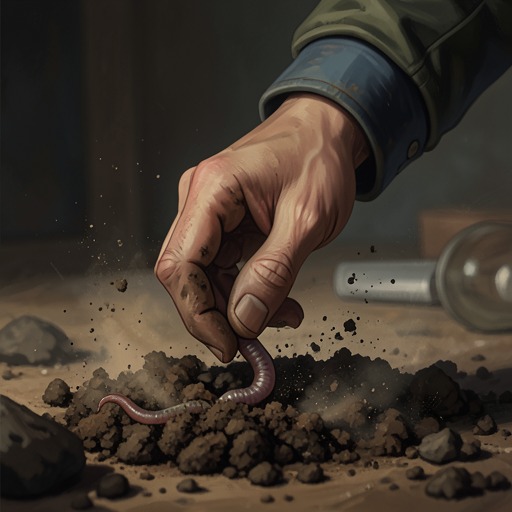
The expression begins as an exchange between an unidentified boy and a questioner. The boy says that they are like worms; asked what kind, he clarifies that they are like worms all over. The questioner proposes worms in the body, but the boy rejects that interpretation. The scene offers no clear explanation of what the worms are, and its dark, constrained setting—rough sheets, a speaker unable to move—makes the image unsettling without resolving it into a literal diagnosis.
The exchange soon shifts from description to investigation. The speaker insists that patience is necessary and that they must find the exact moment when the worms come into being, because the moment matters to everyone. The phrase therefore names not only a sensation or phenomenon but also the central question of its origin. Its uncertainty is purposeful: before the story identifies a cause, it makes the task of locating one part of the narrative itself.
Clues in the Pasture and Water
Carla’s recollection of the stallion provides an earlier sequence of events that connects animal illness to David’s exposure. After noticing that the horse has disappeared, she finds it drinking from a stream. David, then a small child, has put his hands in the water and is sucking his fingers. Carla also sees a dead bird nearby. She gets David away from the stream and returns the horse, but does not tell Omar what happened.
The next morning, the stallion is gravely ill, with swelling around its eyes and mouth. Carla understands the horse’s condition as a warning for her son: David drank from the same water, and she fears that he has little time. Her account makes the stream a concrete possible route of exposure and sets human and animal vulnerability beside one another. It does not provide a chemical identification or a definitive explanation of the horse’s illness; the force of the episode comes from the proximity of the water, the dead bird, and the horse’s sudden deterioration.
Later, the narrative places another environmental clue close to Carla’s effort to take the others to the abandoned Omar’s stables, beside Sotomayor’s farm. A truck arrives while men have been drinking mate. The men put on long plastic gloves and begin unloading large plastic drums, carrying them out of a full truck. One drum is left by itself in the doorway of a shed. The scene does not establish what the drums contain, but its placement gives physical shape to the question of contamination that the worm refrain keeps open.
Sensation, Misdiagnosis, and Recurrence
Amanda’s later account makes the phrase bodily and immediate. Driving under the bright light, she struggles to see, lowers the visor, and searches the glove compartment for sunglasses. Each movement takes effort, and she describes her body as stinging. When she asks whether this is the worms, the answer is that it feels like tiny worms across her body. The image has shifted from an unexplained plural presence to a description of pain spread over the skin.
At the same time, Amanda is worried that Nina will be left alone in the car and fears that this may be the last time she sees her daughter. Her physical difficulty and fear unfold together, but the narration does not reduce the sensation to a metaphor: Amanda is described as poisoned. Earlier, after Amanda and Nina return home, a woman from the emergency room is present and they are given medication for what Amanda identifies as sunstroke. The discrepancy between the treatment and the narration’s assertion of poisoning makes the misdiagnosis part of the story’s account of how the danger is recognized—or missed.
The expression returns once more when Amanda gets out of the car and leans against it, rubbing her eyes because she feels something is in them. Asked how she is, she says that she feels more normal, then describes the last woman passing before the sensation of worms resurfaces. Repetition does not settle the cause; instead, it marks the persistence of bodily distress through moments when Amanda’s account of her condition changes.
A Refrain for Finding the Beginning
The phrase’s importance lies in the way it joins sensation to chronology. The early speaker asks for the exact moment when the worms come into being; the later scenes supply candidate points of contact without turning them into a complete explanation. David drinks from a stream near a dead bird, a horse that has also reached the water becomes ill, and drums arrive in the vicinity of the fields. Amanda and Nina are later described as poisoned, even as sunstroke is treated. These details build an environmental pattern, but the available account does not establish the contents of the drums or prove a single causal chain among every event.
That gap gives the refrain its particular narrative force. “Worms” is not a settled name for a substance or an organism; it is a recurring figure through which bodily evidence, remembered events, and the search for origin meet. The image moves from the boy’s insistence that the worms are everywhere to Amanda’s own description of feeling them across her body. Each return makes the question more urgent without fully answering it: the sensation can be named, and the poisoning can be recognized, while the precise beginning remains the thing the story is still trying to find.